

Online marketing draait om data.
Whether you advertise via Google Ads, run campaigns on Meta, or simply want to know where your revenue is coming from: without reliable data, you are making decisions based on assumptions.
Yet in practice, we see more and more companies struggling with incomplete data in Google Analytics 4, advertising platforms, and conversion measurements. Conversions disappear, campaigns appear to perform less effectively, and reports no longer match actual revenue.
That is no coincidence.
Browsers are becoming stricter, ad blockers smarter, and privacy legislation has a major impact on how data may be collected. As a result, traditional tracking methods simply work less effectively than they did a few years ago.
One solution that is becoming increasingly important is Server-Side Tagging.
In this blog, I explain exactly what Server-Side Tagging is, why it is being used more frequently, and what the benefits are for companies that depend on reliable analytics data and accurate conversion measurements.

What is Server-Side Tagging?
Server-Side Tagging is a method of measuring data where information is not sent directly from a visitor’s browser to external platforms, but first passes through your own server environment.
Sounds technical? It’s not that bad. Normally, tracking on websites works largely through a visitor’s browser. Think of:
- Google Analytics
- Google Ads conversions
- Meta Pixel
- LinkedIn Insight Tag
- Hotjar
- other scripts and tracking pixels
These scripts are loaded in the user’s browser. We call this client-side tracking.
With Server-Side Tagging, that data first passes through your own server container before being forwarded to, for example, Google Analytics or Meta.
This gives you:
- more control over data,
- more reliable measurements,
- less dependence on browsers,
- and often better website performance.
The difference between client-side and server-side tracking
To properly understand Server-Side Tagging, it is important to first know the difference between traditional tracking and server-side tracking.
Client-side tracking (the traditional way)
With client-side tracking, everything happens in the visitor’s browser. A user visits your website, and then various scripts are loaded:
- Google Tag Manager
- Google Analytics
- Meta Pixel
- tracking cookies
- advertising pixels
These scripts collect data and send it directly to external platforms. This worked fine for years, but nowadays there are more and more limitations. Browsers such as Safari and Firefox block an increasing number of tracking methods. Ad blockers also ensure that scripts are not loaded at all. As a result, you miss out on data. And that is exactly where the problem arises.
Server-side tracking
With Server-Side Tagging, you first send data to your own server environment. From there, the information is forwarded to, for example:
- GA4
- Google Ads
- Meta Ads
- other marketing tools
This creates an extra layer of control between the website visitor and external platforms. The big advantage of this is that browsers and ad blockers have less of a grip on that data stream.
Result:
- more reliable analytics data,
- more accurate conversion measurements,
- and better input for advertising algorithms.

Why traditional tracking is becoming less reliable
Many companies assume their data is correct. But in reality, many websites unknowingly miss a significant portion of their conversions. We regularly see this reflected in:
- lower numbers of purchases in GA4,
- discrepancies between webshop revenue and analytics,
- campaigns that suddenly seem to perform worse,
- Meta Ads registering fewer purchases,
- or Google Ads conversions decreasing without a clear reason.
Often this is not due to the campaigns themselves, but to the tracking.
Browsers are blocking more and more
Privacy is becoming increasingly important. Browsers are actively responding to this. Safari, for example, blocks various tracking cookies by default. Firefox does something similar. Google Chrome is also moving more towards privacy-friendly tracking. This makes traditional client-side tracking increasingly unreliable.
Ad blockers are on the rise
More and more users are using ad blockers or tracking blockers. Simply put, this means:
- certain scripts no longer load,
- pixels are blocked,
- and conversions disappear from your reports.
The Meta Pixel is particularly affected by this.
Privacy legislation is changing the playing field
In addition, legislation is playing an increasingly large role. Think of:
- AVG/GDPR,
- cookie banners,
- consent mode,
- stricter rules regarding personal data.
Companies must handle data more consciously. At the same time, they want to maintain insight into marketing performance. Server-Side Tagging helps to gain more control over this.

Why unreliable data is dangerous for your marketing
Many entrepreneurs underestimate the impact poor data has on marketing decisions. Because if your data is incorrect:
- you optimize campaigns incorrectly,
- you direct budget to the wrong channels,
- you scale down campaigns too early,
- or you think marketing isn’t working when tracking is the problem.
An example we often see: A webshop runs Meta Ads and sees only 40 purchases in Meta, while in reality, 65 orders were placed.
The result?
- campaigns appear less profitable,
- ROAS appears lower,
- Meta algorithms receive less data,
- and campaigns optimize less effectively.
Ultimately, you start managing based on incorrect information. And that often costs much more money than companies realize.
How Server-Side Tagging helps collect more reliable data
Server-Side Tagging doesn’t solve everything, but it does help to reduce a large portion of those measurement problems. Because data passes through your own server environment:
- fewer requests are blocked,
- tracking remains more stable,
- and there is more control over which data is forwarded.
In practice, this often means:
- more complete conversion data,
- more stable reporting,
- better connections with advertising platforms,
- and more reliable analytics.
Important to understand:
Server-Side Tagging is not a magic solution that suddenly measures 100% of all data. That simply no longer exists in the current privacy landscape.
But it does help to significantly improve the quality of your data.

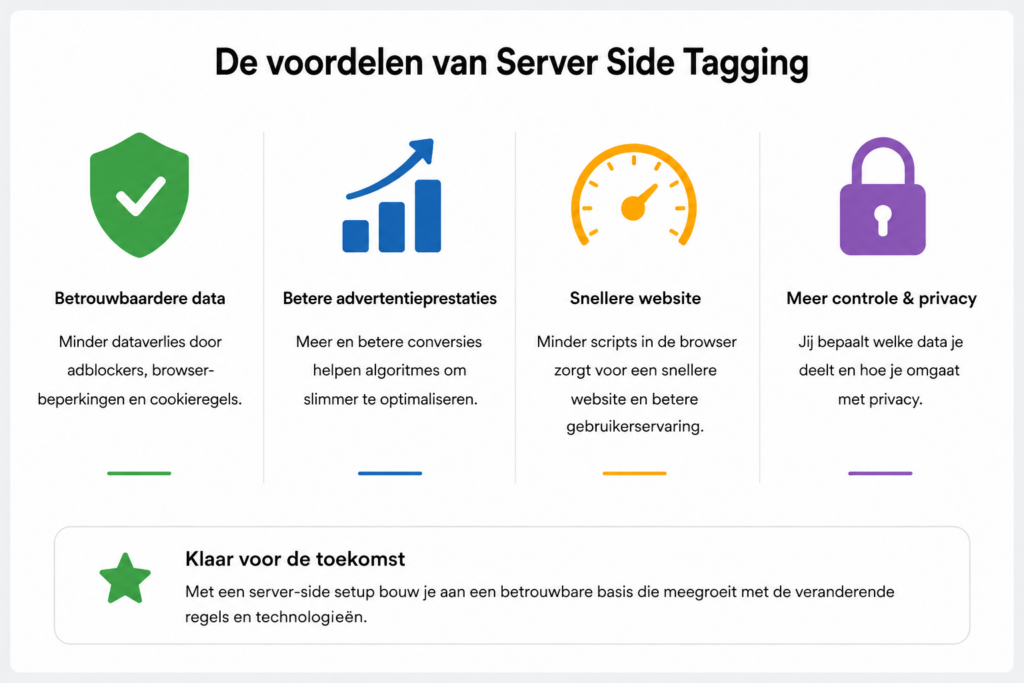
The benefits of Server-Side Tagging
1. More reliable data in GA4
One of the biggest advantages is simply better data. Many companies notice after a proper server-side implementation:
- fewer discrepancies between webshop data and GA4,
- more stable conversion measurements,
- better attribution,
- and more insight into customer behavior.
And better data ultimately means better decisions.
2. Stronger advertising performance
Advertising platforms such as Google Ads and Meta Ads run entirely on data. The better that data is, the better algorithms can optimize. With incomplete tracking:
- platforms miss conversions,
- campaigns learn less quickly,
- and target audiences are built less effectively.
Server-Side Tracking helps to:
- report more conversions correctly,
- provide better signals to advertising algorithms,
- and allow campaigns to run more efficiently.
3. More control over privacy and data
With traditional tracking, you often send all kinds of data directly to external parties. With Server-Side Tagging, more control is created:
- what data do you forward,
- what data do you filter out,
- how long do you keep data,
- and which platforms get access.
This makes it easier to handle data in a privacy-conscious way.
4. Better website performance
Many websites load dozens of external scripts simultaneously. This can make websites slower. With Server-Side Tagging, you move part of that processing to the server environment. As a result, the user’s browser has to process fewer scripts directly. This can contribute to:
- faster loading times,
- better user experience,
- and sometimes even better Core Web Vitals.
5. Stronger first-party data strategy
Third-party cookies are increasingly fading into the background. As a result, first-party data is becoming more important. Server-Side Tagging aligns well with this because you work more from your own domain and your own data streams. For companies that want to handle data and marketing in a future-proof way, this is becoming increasingly relevant.
Why Server-Side Tagging is interesting for webshops
Webshops in particular benefit greatly from reliable tracking. Why? Because e-commerce is entirely dependent on good data:
- which campaigns generate revenue,
- which products convert,
- which target audiences buy,
- which advertisements are profitable.
If gaps appear there, optimizations become difficult. Additionally, webshops often have:
- multiple marketing channels,
- higher advertising budgets,
- greater dependence on remarketing,
- and more conversion data.
That is precisely when reliable tracking becomes important.
Why reliable data will only become more important in the coming years
The time of “just placing a pixel and everything works” is behind us.
Online marketing is becoming increasingly dependent on:
- first-party data,
- smart measurement structures,
- consent management,
- and reliable conversion signals.
Companies that get their tracking in order now will have a huge advantage in the coming years. Not just for reporting, but especially for:
- better campaigns,
- smarter optimizations,
- and scalable online marketing.
Conclusion
Server-Side Tagging is not a hype or a technical gimmick. It is a logical development within an online landscape where privacy, browser limitations, and data quality are becoming increasingly important.
For companies that are seriously dependent on online marketing and reliable analytics data, it can be a massive improvement.
Not because you suddenly get perfect data, but because you:
- gain more control,
- lose less data,
- and create better insights for marketing decisions.
At Studio Piranha, we help companies improve their tracking, analytics, and online marketing data. Not with unnecessarily complicated technical stories, but with solutions that actually contribute to better insights and better marketing results.
Curious if Server-Side Tagging is interesting for your website or webshop? Feel free to contact us.

Common misconceptions about Server-Side Tagging
“Server-Side Tagging makes everything cookieless”
No. Server-Side Tagging does not automatically mean you measure without cookies. It primarily changes the way data is forwarded.
“It replaces Google Tag Manager”
Not that either. In many cases, you still use Google Tag Manager, but extended with a server container.
“Only large companies need this”
That depends entirely on your situation. Smaller webshops or companies with serious advertising budgets can also benefit greatly from better tracking.
“You suddenly measure 100% of all data”
That is simply not realistic. Privacy rules, browser limitations, and user choices will always continue to influence tracking. Server-Side Tagging primarily helps to limit data loss.
When is Server-Side Tagging worth the investment?
Not every company needs to start with Server-Side Tagging immediately. But it becomes interesting when:
- you actively advertise via Google or Meta,
- you are dependent on conversion data,
- you see discrepancies between revenue and analytics,
- you want to scale up campaigns,
- or you notice that tracking is becoming increasingly unstable.
Especially companies with:
- webshops,
- lead generation campaigns,
- higher advertising budgets,
- or complex marketing funnels
often derive a lot of value from a good implementation.
Are there also disadvantages?
Yes, there are. And that is precisely why it is important to remain realistic.
- Higher implementation complexity
Server-Side Tagging requires more technical setup than standard tracking. - Extra costs
Often you use a separate server environment, for example via:
- Google Cloud,
- Stape,
- or your own hosting environment.
There are extra costs associated with that.
- Proper maintenance remains important
Tracking is never a “one-time setup”. Browsers, platforms, and privacy rules change continuously. A server-side setup also requires maintenance and monitoring.
What does an implementation process look like?
An implementation usually begins with an analysis of the current tracking. We look at, for example:
- current data quality,
- discrepancies between platforms,
- existing GTM setup,
- advertising channels,
- and desired measurements.
This is usually followed by:
- setting up a server container,
- linking with tracking platforms,
- configuring first-party data streams,
- testing events and conversions,
- validating data quality.
It is important that this is done correctly. An incorrect setup can actually cause more measurement problems.

FAQ
Voor meer vragen neem vrijblijvend contact op.
Server-Side Tagging is a method of tracking where data is first processed through your own server environment before being sent to platforms such as Google Analytics or Meta.
With client-side tracking, data is sent directly from the browser. With server-side tracking, data first passes through a server environment.
This is often due to browser limitations, ad blockers, cookie settings, and privacy measures.
Yes, Server-Side Tracking can be well combined with Shopify webshops.
It can have a positive effect because fewer scripts need to be loaded directly in the browser.
No. Smaller companies or webshops can also benefit from more reliable data.
Yes, via the Meta Conversions API, you can send server-side data to Meta.
That depends on the complexity of the setup, the number of platforms, and the server environment.
No, but it is becoming increasingly relevant now that traditional tracking is becoming less reliable.
Not entirely. Cookies still often play a role, but the dependence is reduced.
Data that you as a company collect yourself through your own channels, such as your website or webshop.
Advertising platforms optimize campaigns based on data. Poor data leads to poorer performance.
That varies by situation, but usually an implementation takes a few days to a few weeks.
No. Tracking and analytics require regular maintenance and optimization.

