

The customer journey is the path a customer takes from considering your product to purchasing it. By mapping out the customer journey, you can collect a lot of relevant data. This process is called “customer journey mapping.” By optimizing this journey, you ensure that you don’t lose potential customers halfway through the purchasing process, and that you also convince those who are on the fence to make a purchase.
Customer Journey Mapping
You use this “customer journey map” to make the customer’s journey as pleasant as possible. A more pleasant customer journey builds customer loyalty to your company. By mapping out and analyzing this journey, you can also identify where you’re losing certain customers. In short, by mapping out your customer journey, you can tailor your approach to the specific stage the customer is in.
Focus on the stage your customer is currently in
When someone is considering a purchase, there’s no point in sending them the manual just yet. The customer simply isn’t at that stage yet. A product review or a recommendation is much more appropriate at this stage.
There are various stages that a customer goes through. As a result, there is no single, established marketing model. We have identified the stages we frequently encounter. In our experience, these stages are always relevant to the customer journey.
Stages in the customer journey
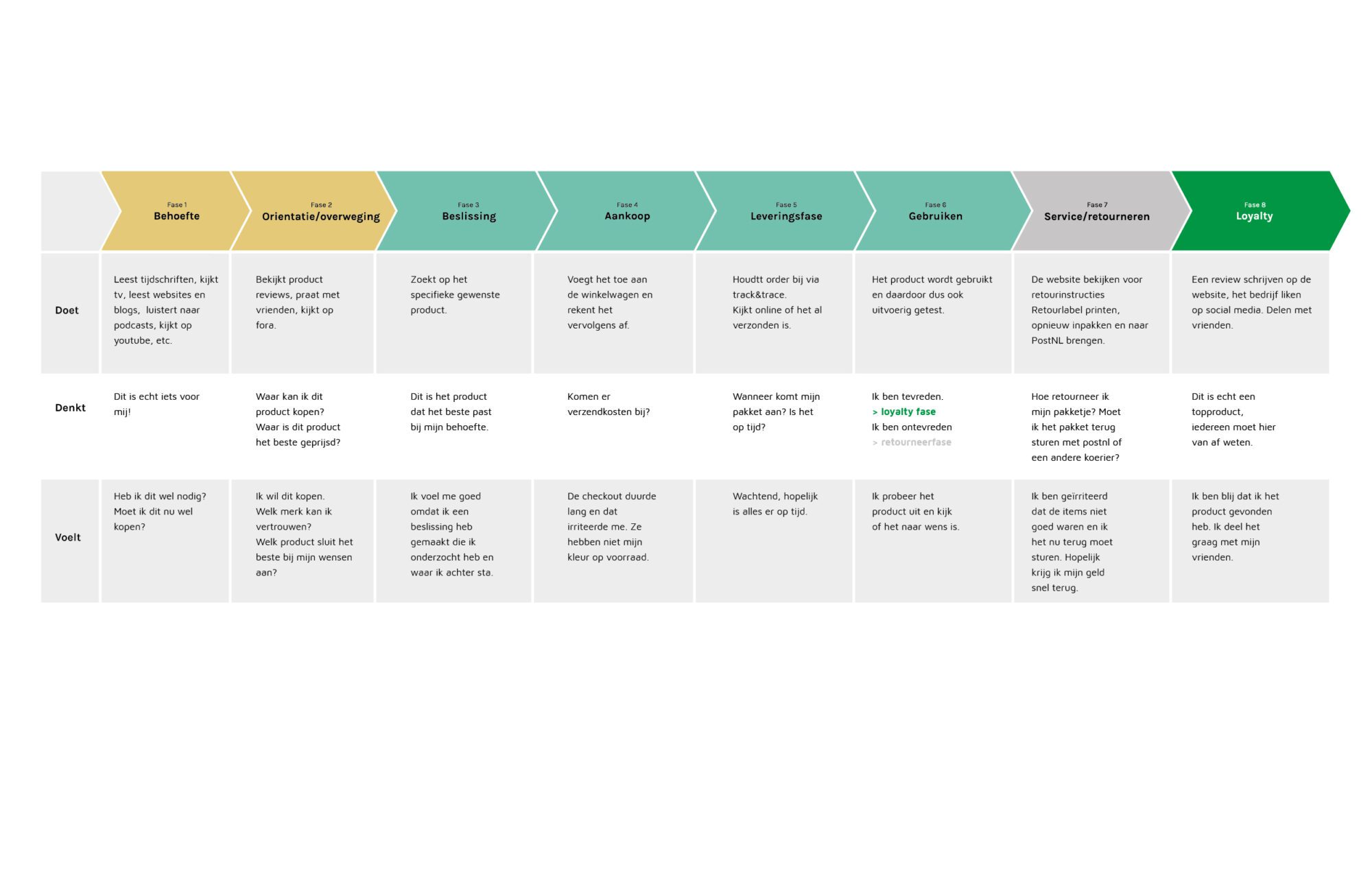 Open/download the full image here
Phase 1: Needs
In this first phase, the customer has a need but may not yet be aware that your product exists. So, in this phase, you need to make sure the customer becomes aware of you.
- online advertising
- offline advertising
Phase 2: Orientation
At this stage, the target audience is aware of their needs and may already be familiar with your company. In this phase, the lead is considering your product. It’s important to show that you know what you’re talking about. At this stage, they’re looking at factors such as price, brand awareness, and other people’s experiences. You can engage these visitors by using various methods:
- Content Marketing
- SEO
- SEA
- Social media groups
- Forums
- Trade shows focused on your product
- A well-designed website that guides visitors
- Comparison sites list
- Encourage current satisfied customers to write a review
Phase 3: Decision Point
Your lead has decided that he wants to buy something.
Phase 4: Point of Purchase
Your potential customer is now becoming a customer. He has decided to make a purchase and is going through with it. Yet many people still drop off at this stage. For example, a customer recently asked us if we could install a “heat map”; using Google Analytics, they discovered that many of their customers were getting stuck on the checkout page of their online store. They never completed their purchase—what a shame!
Tools you can use to check whether everything is running smoothly:
- Google Analytics: Where Do Users Drop Off?
- Heat Maps
- A/B testing
- User Research
Phase 5: Delivery
Buying something for yourself often feels a bit like a treat! When you can turn this moment into a spontaneous experience, it creates a positive experience for the customer. This applies to both online and in-store purchases. For example, Hunkemöller lingerie comes in original packaging, wrapped in a beautiful sheet of paper. When you order from Coolblue, you’ll receive a box with a big “smile” on it. Details that make you happy!
How to Keep Your Customers Satisfied During and After Delivery:
- Email marketing: such as tracking the delivery status
- Content marketing: clear installation tips, user tips, recipes, etc. In short, everything needed to make the customer feel comfortable.
Phase 6: Operational Phase
At this stage, it’s important that the customer is satisfied (and buys more from you). You can achieve this by, for example:
- Email marketing: emails that are relevant to the selected product
- Content Marketing: More Information About the Product
- Good post-purchase services, such as excellent customer support or a chat feature
Step 7: Service and Returns
Ultimately, the goal is for your customers to be so satisfied with your product and service that they’ll come back to you exclusively. Of course, you want to build customer loyalty. However, there may be times when a customer isn’t satisfied with your product.
By handling the returns process well, you can ensure that the customer will come back to you next time. The same goes the other way around: what if a customer wants to exchange a product but finds it difficult to do so on your website? Then they’ll order from somewhere else next time, where exchanges are much easier.
Phase 8: Loyalty
The customer is so satisfied that he recommends your product to others.
It’s hard to see things from someone else’s perspective. That’s especially true when it comes to your own business and your own product, which you’re so enthusiastic about. So ask others what they think could be improved; why did they—or didn’t they—decide to make a purchase?
Customer journey mapping is an excellent tool for monitoring and adjusting every step. By creating a persona and putting yourself in your ideal customer’s shoes, you can clearly identify what’s working well and what could be improved. This allows you to continuously refine your marketing strategy and optimize this process. We’ll explore this further in an upcoming blog post.
Do you have any questions in the meantime? Please call 070 222 60 90 or email info@studiopiranha.nl so we can provide advice tailored to your specific situation.

