

A customer journey map is an ideal tool for mapping out your customer’s journey. But how exactly do you map out this journey, and how do you gather the right information? And what exactly does such a map look like? We’ll show you!
Start with the objective of your customer journey map
For example, you can map out what the ideal customer journey would look like. You can identify where things go wrong for current customers. Before you fill out the form, it’s important to know why you’re doing so. This ensures that you achieve results in a targeted way and don’t end up with just random data.
Determine what your company or product focuses on
You don’t have to map everything out right away, but you can start, for example, with one product or one service you offer. The more specific the focus, the more clearly you can pinpoint what’s going well and what’s going wrong.
Define your customer, for example, using personas
You do need to know who your target audience is. You can identify them using a persona. You can gather the information for this persona in various ways:
- using data
- by defining your ideal customer if you don’t have any data
- A persona consists of a name, age, place of residence, lifestyle, desires, problems, job, etc.
We’ve previously written a blog post about how to create a persona. Check it out here.
Gather all the information you already have
You can do this through surveys, Google Analytics, feedback from staff, or comments on social media. Or have someone go through the process and come up with specific questions to ask that person. So information can come from anywhere!
Walk through the entire process as if you were the persona
Identify every step your persona goes through. Think about when they first come into contact with your company, what they’re thinking at that moment, and so on. Document every decision point.
Identify what they think, feel, and do
At each moment, you then imagine what this persona is thinking and feeling. You then associate an emotion with it: does it make them happy, not so happy, or absolutely miserable?
You can do this using colors, for example (red, orange, green). How does this specific step make my client feel? Does my client feel bad, neutral, or good? Neutral might be an area to work on; bad is definitely an area that needs attention. This way, you can clearly see what needs your attention.
Review the areas that could be improved
Review the entire map you just created and identify areas for improvement. This will help you determine what you can do right away—in the short term—as well as what will require a longer lead time.
When mapping out the customer journey, it’s important that it feels personal. That way, you can better empathize with your customer. Put yourself in their shoes; see things through their eyes. Use “I” in your sentences when describing it; that way, you’ll be better able to put yourself in your customer’s shoes.
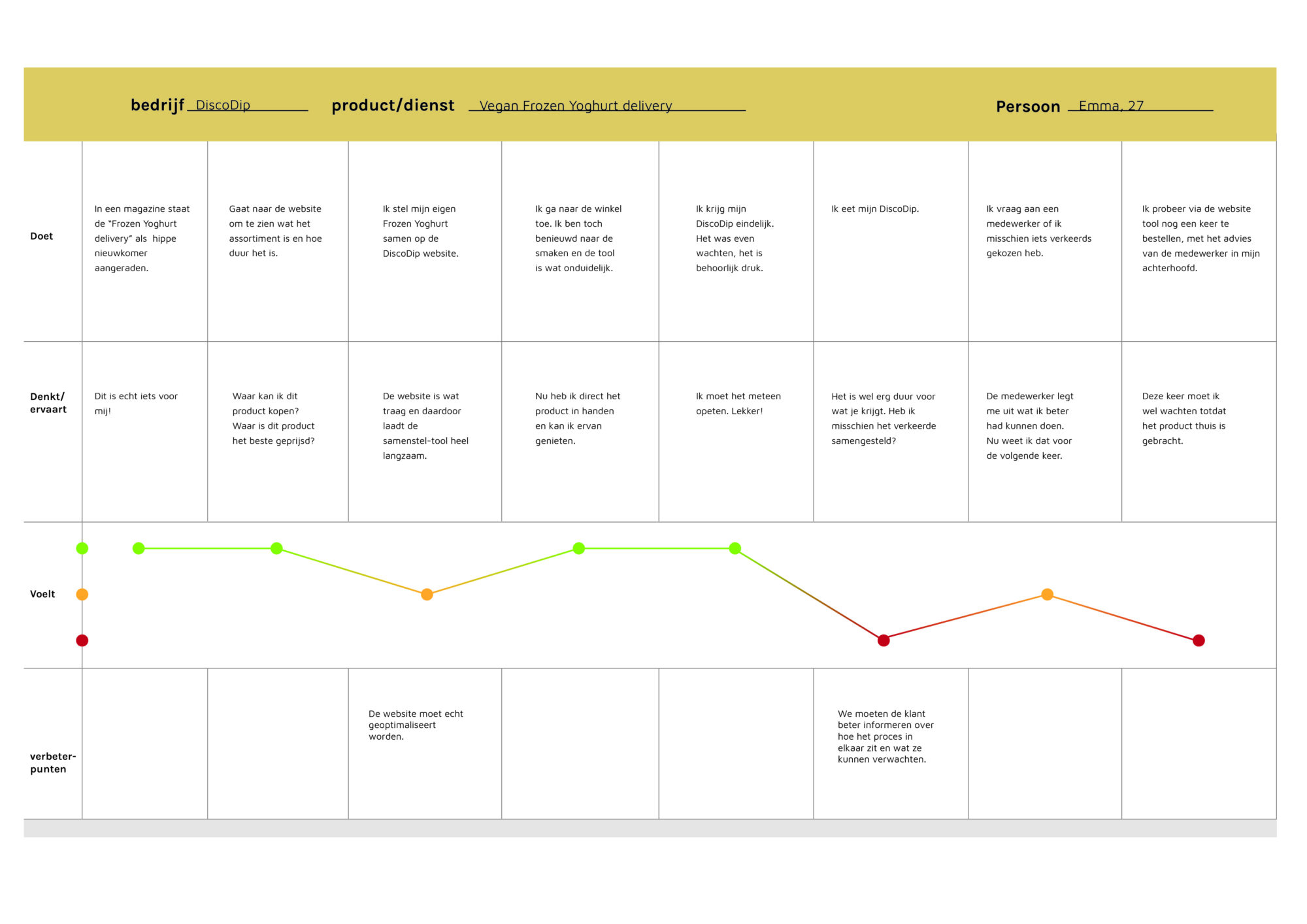 Customer journey example. Click on the image to enlarge it.
Download our free customer journey map to fill out yourself
A customer journey map can be detailed, but it can also be very brief. That’s why we’ve created our own customer journey map, which has been very helpful to us. You can download this map for free here.
Other customer journey information
If you need help filling this out or have a specific question, please feel free to call us! Or check out our other customer journey blog—you might find the answer to all your questions there.

